
Our atmosphere is made up primarily of gases—about 78% of the atmosphere is nitrogen (N2) and 21% is oxygen (O2), with the rest of it is made up of other gases. In addition to these gases, our atmosphere also contains very small liquid droplets and solid particles, known as particulate matter (PM). These particles play an important role in human health and climate, but are so small that when you look at the air around you, you usually can’t see them with your bare eyes. In areas that are highly polluted with particulate matter, however, the difference is clear.
These very small liquid droplets and solid particles are lightweight, so they can float in the air for a long time without falling to the ground; in other words, they are suspended in the air. When particulate matter is suspended in a gas, it is called an aerosol. When you hear the word “aerosol,” you might think of a can of hairspray or spray paint. When you release the hairspray or spray paint out of its can, it releases a mist of small liquid droplets, called an aerosol spray. However, the particulate matter (PM) in our atmosphere can also be referred to as an aerosol because it is suspended within the gases in the air. Because of this, particulate matter can also be called aerosol particles.
Adapted from: https://caice.ucsd.edu/introduction-to-aerosols/
Aerosol particles can contribute to a variety of human health problems. For example, particulate matter affects the health of more people than any other pollutant worldwide. According to estimates from the World Health Organization (WHO), particle pollution contributes to approximately 7 million premature deaths each year, making it one of the leading cause of worldwide mortality.
The health effects of the particles are directly related to their size. Particles greater than 100 μm are generally too large to be inhaled. Particles between 10-100 μm can be inhaled, but are usually stopped by our body’s “filters”—the mucus membranes in our respiratory system. The term inhalable particles typically refers to particles less than 10 μm in size that can make it past the body’s defenses and deep into the lungs. These particles pose the most health risk. Inhalable coarse particles are particles between 2.5 and 10 μm in diameter (PM10) and are typically found near highways and factories. As Figure 8 shows, these particles are usually deposited in the nose, pharynx, and larynx. Fine particles have a diameter less than 2.5 μm (PM2.5) and are typically found in smoke and smog. These particles make it deeper into the lungs; a significant proportion of these fine particles are deposited in the trachea, bronchioles, and alveoli.
Scientific studies have linked particle pollution to a number of health problems such as:
- Aggravated asthma
- Decreased lung function
- Irritation of airways, coughing, and difficulty breathing
- Premature death in people with heart and lung disease
- Nonfatal heart attacks
- Irregular heartbeat
Adapted from: https://caice.ucsd.edu/introduction-to-aerosols/
When we talk, shout, sing, cough, sneeze or simply breathe, we exhale small particles (“aerosols”) that are made of saliva or respiratory fluid (the liquid that wets the inside of your trachea, lungs, etc.). These aerosols are the “carriers” of SARS-CoV-2 viruses and can infect when they are inhaled.
Aerosols are smaller than about 100 μm: for this reason, they can linger more in the air, from tens of seconds to hours, and the smaller ones can travel long distances. They infect by being inhaled through the nose or mouth, or (less likely) by deposition on the eyes. They reach different parts of the human respiratory tract depending on their size. These are the green, yellow, and red dots in the figure below.
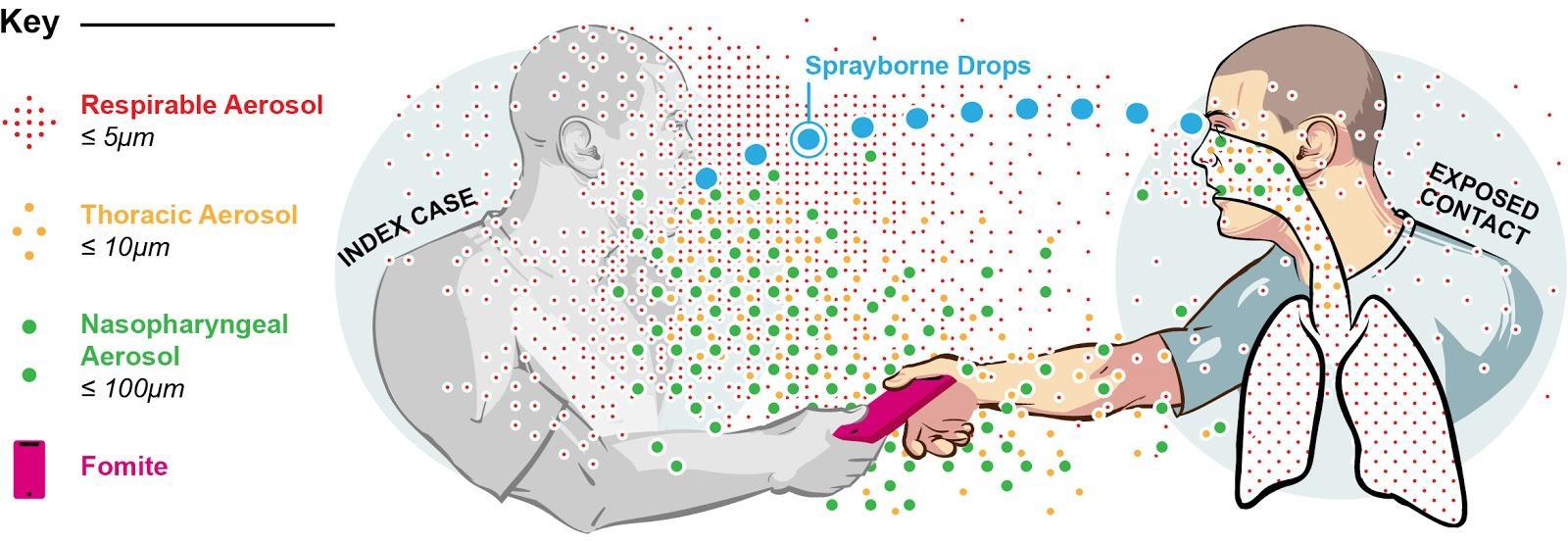
Figure: schematic representation of the droplet (blue) and aerosol (green, yellow, and red) infection pathways for a respiratory disease. Both travel through the air from the infected person to the susceptible person, but ballistic droplets infect by impact, and aerosols infect by inhalation. From Milton (2020), modified by the author (pers. comm.).
Adapted from: FAQs on Protecting Yourself from COVID-19 Aerosol Transmission
What is the size of infectious aerosols? While the size of an individual SARS-CoV-2 virus is very small (120 nm or 0.12 microns), the aerosol in which respiratory viruses are contained are larger, albeit still small enough to remain suspended in air for long periods. A widely held misconception is that the virus is naked in the air, perhaps with some water. This has been propagated by graphics in major medical journals such as JAMA. Our best guess is that the most common aerosol size is a few microns, where the viruses comprise a very small fraction of the aerosol, as exemplified in the figure below. Aerosol size has major implications for the ability of masks and filters to remove it from the air, how deeply it will penetrate the lungs, and determines the loss rate due to gravitational settling in indoor spaces.
Adapted from: FAQs on Protecting Yourself from COVID-19 Aerosol Transmission
Like other recommendations, these social distance rules will reduce risk, but not eliminate it. The 6 feet rule is based on the idea that large ballistic droplets fall to the ground within 6 feet, although they can travel farther in a cough or sneeze, up to 28 ft (8.5 m). The 6 feet rule also helps with aerosols that do not settle to the ground because they are most concentrated close to the person who released them, like cigarette smoke is most concentrated close to the smoker. Dilution over distance is the main reason why social distance reduces transmission of COVID-19.
Where will the concentrated aerosols from a person go? It is almost impossible to say. Indoor air is a constantly changing, turbulent environment. Even though you can’t feel it, indoor air is constantly moving (typically between 0.05 to 0.1 m/sec, or 0.15 to 0.3 ft/sec) due to heat from your body (adults typically give off as much heat as an old incandescent light bulb, 75 to 100 W), sunlight warming surfaces, people moving and breathing, and mechanical heating and cooling induced airflows. You likely have seen this when looking at visible aerosols floating in a sunbeam, or when extinguishing a candle indoors. The aerosols rarely are all going in the same direction.
This constantly changing environment will dilute plumes of aerosols. The dilution will be greater with more time and space. Hence, the farther away you can be from other people indoors, the better.
Adapted from: FAQs on Protecting Yourself from COVID-19 Aerosol Transmission
We can never be perfectly safe, only safer. Hence, we should take as many steps as possible to reduce the risk of our activities. You should try to avoid or reduce as much as possible situations that facilitate inhaling the “smoke” (exhaled air) from others. To reduce risk avoid:
- Crowded spaces
- Close proximity to others
- Low ventilation environments
- Long durations
- Places where people are not wearing masks
- Talking, and especially loud talking/shouting/singing
- High breathing rates (e.g., indoor aerobic exercise)
Each one of these features potentially increases the aerosol concentration you might inhale indoors. So if you must enter one of the above situations, complete your tasks as quickly as possible to reduce your exposure duration and risk.
Adapted from: FAQs on Protecting Yourself from COVID-19 Aerosol Transmission
All data show that outdoors is far safer than indoors, for the same activity and distance. But that does not mean that outdoors is 100% safe, and cases of transmission (here and here) have been traced to outdoor conversations. Engaging in riskier activities outdoors may undo some of the benefits. Crowded outdoor locations, especially in more confined spaces (e.g. between two tall buildings) under low wind conditions and not in the sun, are the riskier ones. This is because there is less wind to disperse the virus-laden aerosols, and less UV to deactivate the virus.
The risk of transmission is much lower outside than inside because viruses that are released into the air can rapidly become diluted through the atmosphere. Again, think of the smoke analogy, if you are outdoors and you could inhale a lot of smoke if the people near you were smoking, then there is more risk. But again, outdoors is much safer than indoors.
Adapted from: FAQs on Protecting Yourself from COVID-19 Aerosol Transmission